Most people applying for jobs now use AI somewhere in the process, and most of them are using it for exactly the task it handles worst. Used well it removes the friction that stops people applying at all. Used badly it produces an application that is fluent, confident and completely forgettable.
The dividing line is simple: AI is good at working with your material, and bad at inventing material for you.
What it genuinely helps with
Turning duties into results. This is the single most valuable use. Paste in a flat bullet point, such as "responsible for managing supplier accounts", and ask what information is missing to make it a measurable achievement. It will ask you how many suppliers, over what period, with what outcome. Those are the right questions, and answering them is what improves the line. You supply the facts; it supplies the structure.
Cutting your draft down. People are poor editors of their own writing. Asking for a two-page CV to be tightened to one, or a rambling paragraph reduced to two sentences, works well because the judgement involved is mechanical rather than personal.
Finding your own vagueness. Ask it to list every claim in your CV that has no evidence attached. It will find "excellent communication skills" and "results-driven professional" immediately. This is uncomfortable and useful.
Interview practice. Give it the job advert and ask for the ten questions most likely to come up, then rehearse aloud. It is a genuinely good substitute for a friend who does not have time to run a mock interview.
Research and translation. Summarising what a company does before an interview, or checking that your English reads naturally if it is not your first language, are both low-risk and high-value.
What backfires
Generating the whole thing. A fully AI-written CV or cover letter has a recognisable texture: smooth, evenly weighted, slightly grand, and empty of anything specific. Recruiters read hundreds of applications a week and have become fast at spotting it. The problem is not that a machine wrote it. The problem is that it reads like every other one, and the entire purpose of an application is to be distinguishable.
Letting it invent experience. Asked to make a CV stronger, a model will often quietly upgrade "assisted with" to "led", or attach a plausible percentage to a result that has no number. You will be asked about those details in the interview, and the follow-up question is where it collapses. Never let a claim onto your CV that you cannot narrate in specifics for two minutes.
The wrong company name. The most common visible failure, and it comes from generating letters in bulk. If your message thanks a company for an opportunity that belongs to a competitor, the application is over.
Buzzword inflation. Models default to a corporate register: leveraged, spearheaded, synergies, passionate about excellence. It sounds professional in isolation and hollow in aggregate. Plain verbs beat impressive ones.
Losing your own voice. If your written application sounds like a management consultant and you do not, the interview will feel like a different person turned up. Consistency between your documents and yourself matters more than polish.
AI is also screening you
The traffic goes both ways. Employers increasingly use automated tools to summarise applications, rank candidates against a job description, and in some cases run first-round video screening.
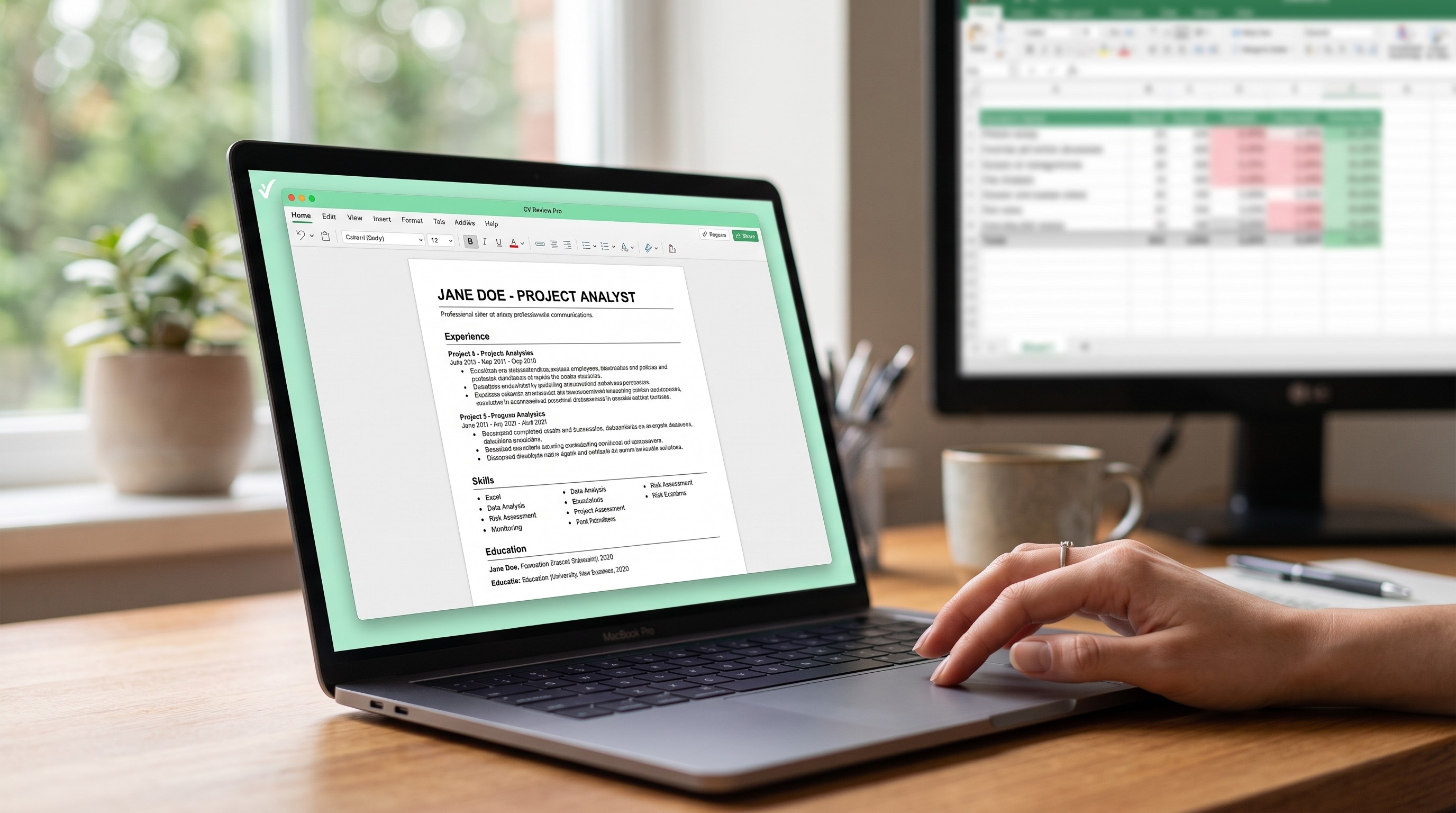
Two practical consequences. First, structure and clarity matter more than ever, because a machine parsing your CV needs conventional headings, real text rather than graphics, and a single-column layout. Second, specific nouns matter: automated matching keys on concrete terms such as systems, certifications and tools, not on adjectives about your work ethic.
The irony is that writing for an automated reader and writing for a hurried human reader require the same things. Be clear, be concrete, be conventional in structure.
Should you say you used it?
For an ordinary application, no, and nobody expects you to. Using a tool to draft and edit your own writing is unremarkable, in the same way spell-check is.
The exception is when an employer explicitly asks candidates not to use AI for a task, most often a written exercise or a take-home assignment. Ignoring that instruction is a straightforward honesty problem, and it is the sort of thing that ends a process when discovered later. If they set the rule, follow it.
A workable method
Write the first draft yourself, badly if necessary. Facts, dates, numbers, in your own words. Then use AI to interrogate and tighten it: what is vague here, what claim has no evidence, cut this to one page. Then read the result aloud and change anything that does not sound like you.
That order matters. Drafting yourself and editing with AI produces something specific and human. Generating with AI and editing yourself produces something generic that you have merely rearranged, and generic is the one thing an application cannot afford to be.